
Spring FDOC: Boston's 4th Snowiest Day
How cold has it been this semester, really?
Last week, at the age of 20, I checked a childhood dream off my bucket list: I can now proudly say that I have sledded down a hill. As a born-and-raised Californian, I have always been excessively enthusiastic about snow. Much to the dismay of friends, I eagerly embraced the snowfalls of my freshman and sophomore years. I was the first to text every group chat whenever I saw a snowflake, and the last to leave a snowball fight. In hindsight, the gentle flurries were just enough to placate my yearning for the True East Coast Experience and building snowmen without bringing my notice to the havoc wintry weather can cause.
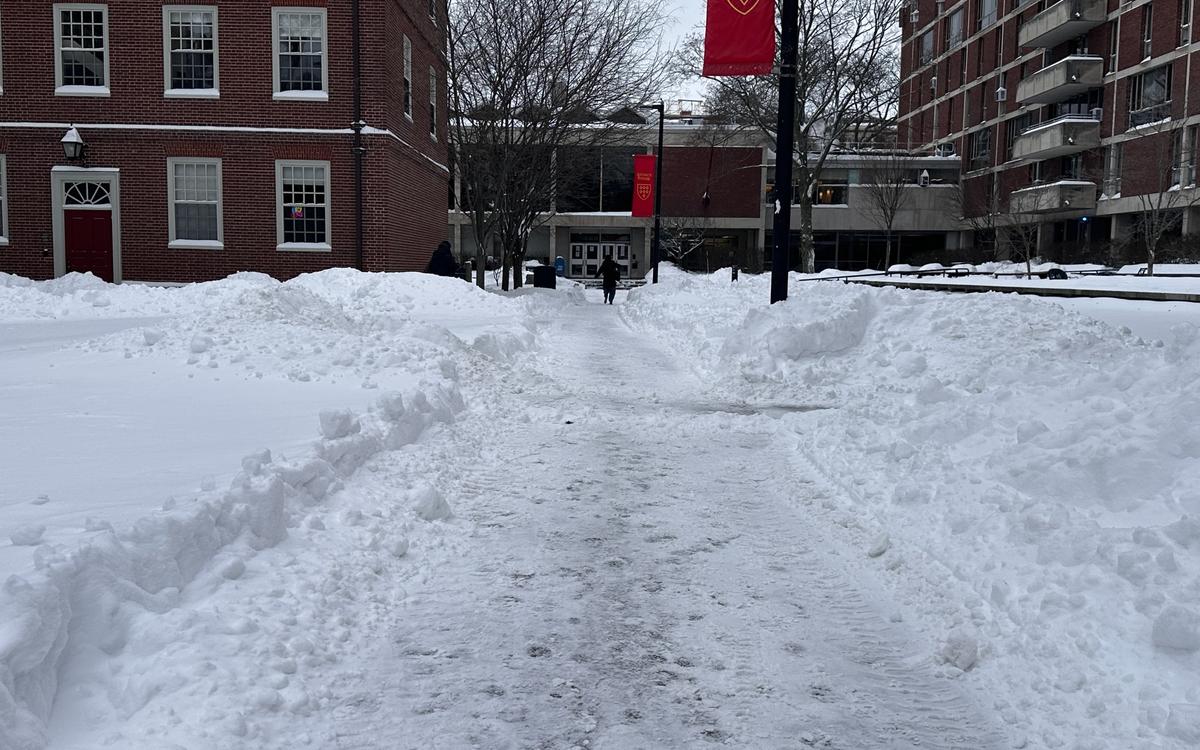
Stepping back onto campus two weeks ago with blissful ignorance, I couldn’t help but be shocked when, on the first day of class, I was pelted in the face by bitter winds and over 20 inches of snow creeping up against my window. In the coming days, I would trudge to class in knee-high dirty slush, the Red Line would be cripplingly delayed, and I would lament the snow days granted to my friends at Tufts at MIT but not Harvard. With it being too cold outside to do much of anything, and being unfamiliar with how to handle the blizzard, I turned to understand the massive influx of snow through what I know best: data.
Using the Climate Data access tool provided by the National Oceanic and Atmospheric Administration (NOAA), I pulled daily snowfall, snow depth, and temperatures tracked since 1893 by the Blue Hill Observatory, the oldest continuous weather record in America, located 11 miles away from Harvard Square. Through this, I found that FDOC was the 4th snowiest day ever recorded there. However, this year was not particularly noteworthy in terms of snow depth, which is the total vertical height of both new and old snow on the ground: in that category, the blizzard of 2015 took the top spots. Not-so-coincidentally, this was the last time Harvard held a snow day.
When visualizing Boston’s weather, I felt inspired to recreate Ed Hawkins’s famous climate spiral, which I had the opportunity to see in person at the Museum of Modern Art in New York last summer. Below is my version of the climate spiral using Blue Hill Observatory’s daily low temperature over the past 133 years. In the early 20th century, weather appeared to be getting more extreme in both directions, but over the past 20 years, days seem to have primarily been getting hotter.
Under current climate conditions, it’s hard to predict the next time Harvard might cancel classes for the snow. In the meantime, though, you can probably find me building an igloo.