

Differences in Migration Rates by Country Income
Migration has been a very contentious topic as of late, as well as debates over where migrants come from and where they ultimately migrate to. This blog post explores the relationship between a country’s migration rate and income level.
Introduction:
Migration has been a very contentious topic as of late, as well as debates over where migrants come from and where they ultimately migrate to. This blog post explores the relationship between a country’s migration rate and income level.
Data:
The analysis is based on an extensive database by the United Nations Population Division, which includes over 50 variables and spans the past 80 years, categorized by region, income level, and specific countries. I focused on the net migration rate and country income in an attempt to establish a clear relationship between the two.
Migration Rate by Country Income:
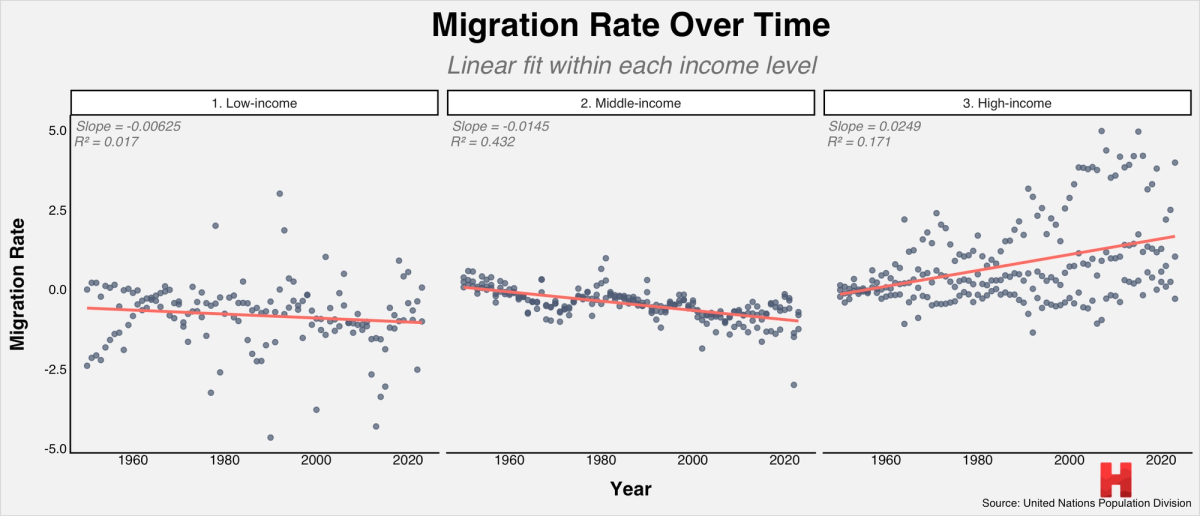 Figure 1
In low and middle-income countries, net migration rates are negative, meaning that more people are leaving than entering. The opposite can be seen for high-income countries. Interestingly, the slope of the line for middle-income countries is more negative than that of the low-income countries. This could be due to the fact that middle-income countries would have more resources, thus allowing their citizens more ability to travel, leading to a greater opportunity to emigrate. Furthermore, there is an increasing vertical dispersion over time in the high-income country plot, which is absent in the others. Such a phenomenon, known as heteroscedasticity, suggests a growing divergence in migration outcomes among high-income countries, perhaps reflecting increasing differences in policy and labor demands.
Conclusion:
There are very strong economic motives for migration; low and middle-income countries have negative migration rates while high-income countries have very high migration rates. This reflects trends that are often observed even without the necessary data to prove that this is happening across the globe. It can also be concluded that over the past several decades, migration rates into high-income countries have been continuously increasing as there is an increasing number of migrants leaving low- and middle-income countries. Even with this generally upward trend, the heteroskedasticity in migration outcomes suggests a growing cross-country difference. Indeed, while some governments of high-income countries may embrace this change, others have found this to be a troublesome trend and are actively taking steps to slow this. However, this trend appears to have persisted for so many years that it may not be possible for it to be halted, as some governments wish for it to be, until some sort of major change or event happens that ultimately weakens this already powerful trend.